- Company
- Industries
- Product areas
- Technology
- Jobs and Career
- Apprenticeship
- News

Electrification is transforming drive systems across nearly every industry. While it improves efficiency, it also introduces new challenges. One of these is bearing currents.
They are caused by electrical potential differences within the drive system and can significantly reduce bearing service life. As a result, developers and plant operators increasingly face the question: Which bearing technology is best suited for electrified drives?
Hydrodynamic bearings can be a suitable alternative to conventional rolling-element bearings. Their load-carrying lubricant film can reduce the risk of electrical bearing damage and contribute to the reliability of electric drive systems.
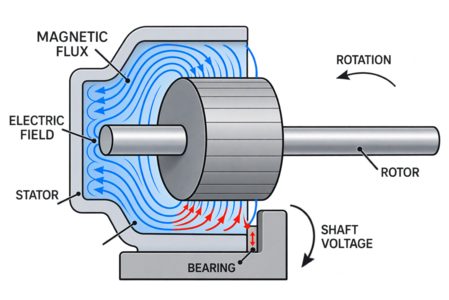
Electric drives often use inverters and power electronic components to precisely control speed and power. The resulting voltages can cause electrical currents to discharge through shafts and bearings.
If the electrical voltage reaches a critical level, it can break down the contact point in the bearing. Current then flows through the bearing location. This effect is referred to as bearing current or current passage.
As industrial equipment, vehicles, and energy systems become increasingly electrified, bearing currents are becoming more significant. High-performance inverters enable high efficiency, but they can also generate unwanted electrical voltages within the drive system.
As electrification advances, it becomes increasingly important to consider bearing locations not only mechanically, but also electrically.
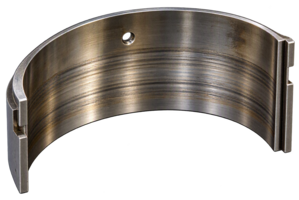
Electrical current passage may initially go unnoticed. Damage often develops gradually and is not detected until bearing performance has already been affected. Examples include:
Bearing currents are often not detected until late in the process. At first, electrical discharges leave microscopic changes on the surfaces. Over time, these can develop into visible damage patterns.
One of the most widely recognized forms of damage is fluting. It can cause vibration, noise, and ultimately premature bearing wear.

Rolling-element bearings transmit loads through point or line contacts. Hydrodynamic bearings, by contrast, operate with a load-carrying lubricant film that separates the shaft from the bearing surface.
This difference can be critical in electrified drives.
A key advantage of hydrodynamic bearings lies in their operating principle. During steady-state operation, the shaft is fully surrounded by a load-carrying lubricant film that separates the metallic surfaces. This oil film not only reduces friction and wear, but can also make an important contribution to electrical insulation.
This fundamentally distinguishes hydrodynamic bearings from bearing concepts that transmit loads through direct contact surfaces. Because there are no permanent metal-to-metal contact points between the shaft and the bearing, the conditions that lead to electrical damage can be significantly reduced. This can help prevent surface damage, improve operating reliability, and extend bearing service life.
Hydrodynamic bearings can therefore help improve the long-term reliability of drive systems and prevent unplanned downtime.
As electrification increases, bearing currents are becoming more important in a wide range of industrial applications. Systems that use high-performance electric motors, generators, or modern inverter technologies are particularly affected.
The specific application requirements are always decisive. Loads, speeds, lubrication, installation space, and electrical influences must be considered as a complete system.
At Miba, this means taking a holistic view of bearing locations. Mechanical, tribological, and electrical requirements are discussed together as early as the development phase. Drawing on our many years of experience, we work with you to evaluate whether a hydrodynamic bearing solution could be suitable for your application.
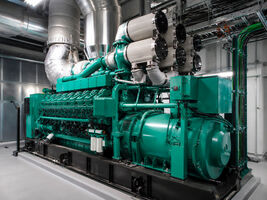
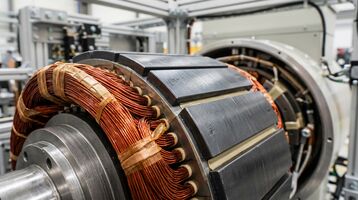
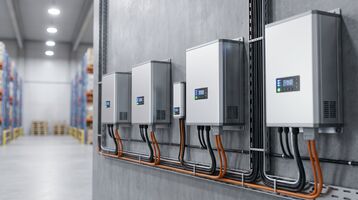
Bearing currents are among the key challenges in modern electric drive systems. With their load-carrying lubricant film, hydrodynamic bearings can offer a natural approach to reducing the risk of electrical damage.
As electrification increases, bearing selection is becoming more and more of a system-level decision. Considering mechanical and electrical requirements together creates the foundation for robust, efficient, and future-ready drive systems.
As a development and solutions partner, Miba supports customers in designing bearing locations holistically and adapting them to the requirements of modern drive systems. Drawing on our many years of experience in hydrodynamic bearing technology, we work with our customers to assess the requirements of electrical systems and develop solutions that can sustainably improve reliability, efficiency, and service life.


