- Company
- Industries
- Produktbereiche
- Technology
- Jobs and Career
- Apprenticeship
- News

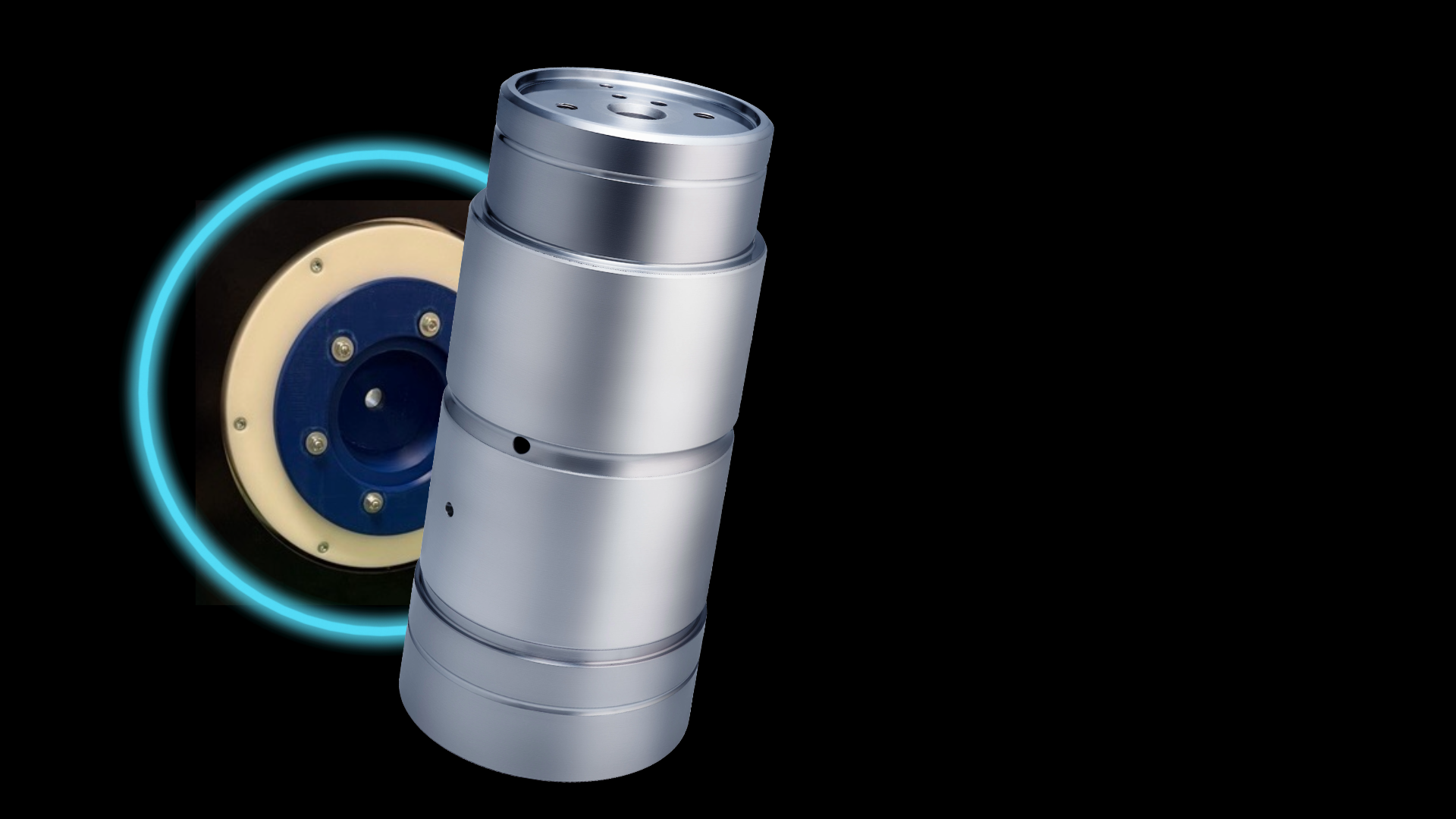
Electromagnetic pulse technology (EMPT) uses strong magnetic pulses to form, join or coat metals without contact or heat. Among other things, it is suitable for directly applying tribological sliding layers to components such as steel beams, as it creates robust multi-material bonds such as aluminum or copper on steel with high adhesive strength.
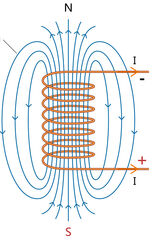
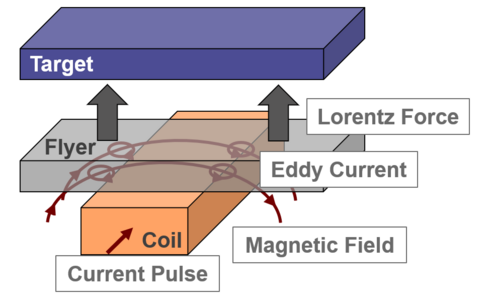
Electromagnetic pulse technology is based on an extremely short high-current pulse (100 kA–1 MA, <1 ms) that is conducted through a coil and generates a strong magnetic field. This induces eddy currents in the workpiece, causing repulsive Lorentz forces to reshape the metal at the speed of sound or apply it to a carrier - completely contact-free and without heat. Electromagnetic pulse technology enables the application of temperature-sensitive aluminum or copper alloys to steel without altering the structure. This significantly improves the direct application of tribological sliding layers.
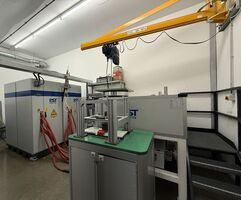
Large capacitors store electricity like a battery, which is then conducted through a coil in milliseconds as an extremely powerful current surge (up to 1 million amps) – this generates a powerful magnetic field.
1. Charging: Charge the capacitor bank to kV level in 3–8 seconds
2. Pulse: High-current switch discharges 100 kA–1 MA in <1 ms through the tool coil
3. Magnetic field: Transient field (several tesla) arises locally at the workpiece
4. Induction: Opposing eddy currents in the conductive metal (aluminum/copper)
5. Acceleration: Lorentz forces accelerate workpiece to near the speed of sound (<25 µs)
6. Contact: Plastic deformation or material bonding
The entire cycle takes only a few seconds (5 to 10 seconds) and is scalable from prototype to series production.
Erfahren Sie mehr über die EMP Technologie und unsere Kompetenzen in unserem Video:

Would you like to learn more about electromagnetic pulse technology?
Our technical team will be happy to answer your questions!
EMP technology enables a wide range of precise manufacturing processes through highly dynamic, contactless material processing.

Ring, pipe, or plate connections, including multi-material (aluminum-steel), are joined cold and without additional material; strengths often reach 80-100% of the base material.

Precise production of direct coatings: Thin-walled bushings are compacted homogeneously onto shafts. This creates reliable bearing coatings with >99.9% compaction, backlash-free fit, and consistently low frictional resistance through form-fit.

Tubes can be drawn in, expanded, drilled, or given complex contours—without tool marks or mechanical contact with the surface, which preserves surface quality and structure.

Localized field concentration separates pipes or profiles with minimal burrs through targeted plastic deformation, without wear tools or thermal zones.
Hydrodynamic bearings function by means of a self-forming lubricating film: This enables high specific loads (p >100 MPa), speeds (v >50 m/s), and extremely long service lives with minimal friction, but requires precise sliding layers with embedding capability and emergency running properties.
EMP technology optimizes the production of these sliding layers. Bushings made of aluminum or copper alloys, which possess the desired tribological properties, are applied to steel carrier bodies cold and without contact, thus avoiding structural changes, distortion, and heat influence. This is crucial for the tribological properties under high hydrodynamic loads.

No heat influence: Unlike laser cladding or sputtering, the structure of the substrate remains unchanged. There are no hardening or softening zones and only minimal risks of distortion.

Form-fitting and material-locking multi-material connection: Aluminum adheres to steel with strengths close to the base material (80–100%), ductile and corrosion-resistant. Copper on steel with EMPT also achieves high strengths close to the base material (70–95%) in multi-material joints. Copper joints have better thermal conductivity with high heat dissipation. These are often used for bearing bushings with integrated cooling structures or electrical contacts in bearings.
![[Translate to English:] Icon Nachhaltigkeit](/fileadmin/_processed_/1/4/csm_co2_footprint_0d55fa9401.png)

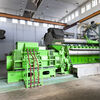


With its electromagnetic pulse technology, Miba offers a highly integrated complete solution with a fully coated shaft—either as a standard Miba shaft or directly with customer-specific shaft blanks.
Compared to thermal press fits, there is no need for additional sleeves, adapters, or retaining elements, which enables significant space savings (typically 10–20 mm radial reduction) and reduces the overall weight. Large shaft diameters are possible without distortion, as the process remains local and heat-free—ideal for large engines and wind power transmissions.
EMPT performs well in direct comparison with other coating technologies in terms of material, component size, and system integration when thermal processes reach material or deformation limits.
| EMPT | Thermal press fits | Laser cladding | Sputtern/PVD | |
| Thermal effect | None (cold, <100°C HAZ) | High (ΔT 100–300°C, voltages) | Medium (HAZ 0.5–2 mm) | None (plasma <200°C) |
| Material combinations | Any (aluminum/copper on steel) | α-expansion pairing (steel/bronze) | Limited (aluminum, coated) | Limited (thin layer) |
| Installation space | Minimal (0) | +10–20 mm radial (sleeves/adapters) | Minimal | Minimal |
| Diameter | >500 mm without distortion | ≤300 mm (critical for warping) | ≤200 mm | <1 m² area |
| Delay | <0,05 mm | 0,1–0,5 mm | 0,1–0,3 mm | None |
| Adhesion | ~50 MPa (80–100% basis) | Friction lock (2-5 MPa) | 30–60 MPa | 20–40 MPa (adhesion) |
Have you reached the limits of your press-fit or coating technology?
We will analyze free of charge whether EMPT can optimize your components. Contact us now!

Electromagnetic Plus Technology (EMPT) is innovative and can be implemented safely and predictably with Miba.
Our comprehensive testing and development platform and a simulation model validated in collaboration with leading universities provide information on adhesion, material penetration into the carrier structure, and long-term tribological properties even before production begins.
We accompany you step by step from the concept through the prototype phase to series production approval and optimally adjust all EMPT process parameters to your application.
The result: optimized components, high process reliability, and a cooperative partnership in every phase of the project.
Would you like to know how EMPT works and whether the technology is suitable for your application?
Then talk to our experts. We will review your requirements together and find the right solution.


