Sputter bearings are hydrodynamic bearings in which thin films applied using a sputtering process ensure robust performance under high-load conditions.
For engine developers, this means:
minimal frictional wear and maximum wear resistance for reliable continuous operation and quick starts.
Learn more about the manufacturing, function, and design of sputter bearings for diesel and gas engines in the article below.
A sputter bearing essentially functions like a conventional hydrodynamic bearing:
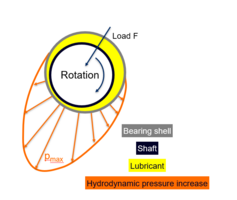
A load-bearing oil film forms between the shaft and the bearing shell during relative motion. Ideally, the shaft does not make metal-to-metal contact with the bearing surface but rather “floats” on the oil film. The load is supported by the hydrodynamic pressure within the lubricating film. Start-up, shutdown, load changes, low rotational speeds, high ignition pressure peaks, and contamination are critical because they can lead to mixed friction.
The difference, therefore, lies not in the hydrodynamic principle itself, but in the surface technology of the bearing shell.
Sputtering (also known as cathode sputtering) is a PVD process in which atoms are dislodged from a solid material by high-energy argon ions and deposited onto the bearing surface as an ultra-thin, compact layer under vacuum. First, the surface is cleaned with ions to achieve high adhesion strength; then, magnetron sputtering creates a uniform layer with an extremely fine-grained composition.
The result is bearing surfaces that help minimize friction and wear, withstand operating temperatures of up to 200 °C, and can ensure a long service life even under vibration and high mechanical loads.
In large engines, sputter-coated bearings are used where the load is highest - at the main and connecting-rod bearing locations.
The thin film applied using the sputtering process forms a highly durable sliding surface. The wear layer is significantly thinner, harder, and also much more wear-resistant than in conventional bearing shells with, for example, an electroplated wear layer.
This allows large engines to be operated at higher combustion pressures and under more frequent mixed-friction conditions without the bearing location becoming a critical factor for reliability and availability.
Sputter bearings are multilayer composite sliding bearings in which a conventional bearing base is combined with, for example, a sputtered aluminum alloy running layer.
A simplified representation of the typical structure of a sputter bearing is as follows:
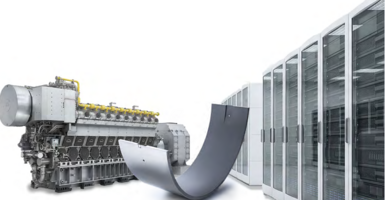
Miba Sputter bearings ensure a reliable power supply in AI data centers by providing reliable continuous power and rapid emergency starts in highly efficient large-capacity gas engines and diesel generators right on site.
In large gas engines for on-site power generation, Miba hydrodynamic bearings with a sputter-coated surface and a Synthec® running-in layer ensure high load-carrying capacity—up to 160 MPa, depending on the design—and combine minimal mixed friction and high wear resistance with rapid starts during emergency operation.
In this way, Sputter bearings play a crucial role in ensuring that AI data centers can operate stably and efficiently - with up to 99.999 percent availability, even in the face of rapidly growing energy demands and grid instabilities.
You can also read more about this in our annual report article
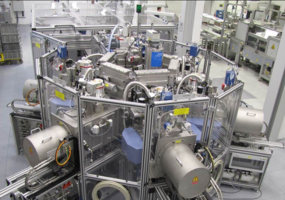
In addition to bearing technology, the special-purpose machinery division Miba Automation Systems develops and manufactures its own sputtering systems for the PVD coating of high-performance components.
Our sputtering systems are used, among other things, for coating engine bearings, transmission components, and aerospace parts, and are designed to produce extremely precise, homogeneous coatings in the micrometer range.
Thanks to close internal collaboration between bearing development and equipment engineering - from the design of magnetron sputtering processes to customized automation - Miba can offer complete solutions from a single source.
Other manufacturers of aluminum hydrodynamic bearings, such as KS Gleitlager, also rely on sputtering systems from Miba. Read more about this in the MTZ article
Sputter Bearings for Highly Charged Diesel Engines