Both processes create an indissoluble metallic bond, but they differ in their mechanisms, strengths and applications.
This article explains:
In clad composite sheets - whether produced by explosive cladding or roll bonding - two or more metal layers are permanently and metallically bonded together. This process does not involve any adhesive layer, electroplating or thermal spray coating.
The bond is formed through direct atomic contact between the metals.
Whether explosive cladding or roll cladding: both processes are based on the same basic principle:
Coatings can peel, delaminate, or fail during forming. Clad composite sheets do not. They can be bent, deep-drawn, and welded just like a single material.
This offers particular advantages in applications where high mechanical strength, corrosion protection, and formability are all required at the same time
.
Clad composite sheets do not replace solid material. They enable designs that would not be feasible with solid material.
Cost advantage: Expensive overlay metals such as titanium, nickel or stainless steel are used only where they are needed. The base material - usually structural steel - bears the load. The overlay metal protects the surface. This saves on materials and costs.
Customized properties: Strength, corrosion resistance and electrical conductivity can be combined in a single component without welding or bonding.
Can be processed like solid material: Clad composite sheets can be bent, deep-drawn, welded layer by layer and cut. The bond withstands these processes without delamination.
Possible applications: Chemical processing equipment and reactors, pressure vessels, automotive oil coolers, electrical contact parts and heat shields in exhaust systems.
Roll bonding is the most widely used process for producing bonded composite sheets. There are two variants, which differ in terms of process temperature, final thickness and applications.
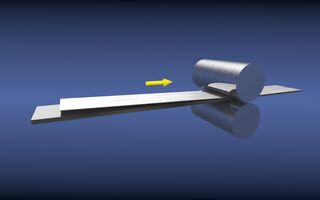
In cold roll bonding, the metal layers are cold-rolled after undergoing a specific pretreatment. This is followed by an annealing process to stabilize the bond.
Advantages of cold roll bonding: precise coating thicknesses, high repeatability, and good scalability for mass production. The thermal stress is low, which protects sensitive material combinations.
Typical material combinations:
Copper-steel: for coins (decorative copper and inexpensive steel)
Aluminum-steel: for the corrosion resistance of aluminum in the automotive industry
Copper-aluminum: electrical contacts, etc.
Typical applications: Steel combined with various special tribological alloys. Miba uses this as raw material for bearing production (ranging from individual parts for 2-stroke marine engines to tens of thousands of parts for truck applications).

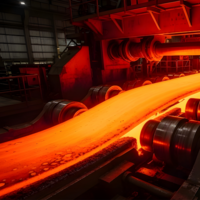
In hot-rolled cladding, the metal layers are assembled into a package, vacuum-sealed, heated to rolling temperature, and then rolled together.
The result: heavy plates with thicknesses of up to 150 mm, lengths of 10 to 12 m, and widths of 2.5 to 4 m.
Typical applications: The process is suitable for applications that require large dimensions and high base material thicknesses.
Explosive cladding works without heat. That is the essence of the process. Here is the basic principle:
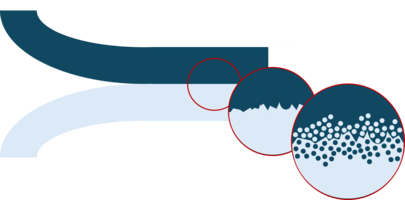
The result: A wavy structure forms in the bonding zone. This wavy pattern is not a defect. It is evidence of the mechanical interlocking of the materials.
Advantages: Because no heat treatment is required, no brittle intermetallic phases are formed. This makes thermal spraying a viable option for material combinations that are thermally incompatible, such as aluminum on copper.
Explosive cladding covers the widest range of materials of any cladding process.
Possible thicknesses: Cladding thicknesses ranging from 1 to 15 mm are possible. The thickness of the base material is practically unlimited.
Typical applications: Pressure vessels, reactor vessels, piping in the chemical industry, seawater desalination plants.
Which process is right for you? The answer depends on three factors: material combination, geometry, and quantity.
| Criterion | Hot roll bonding | Cold roll bonding | Explosive cladding |
| Product form | Heavy-gauge & thin-gauge sheet metal | Sheet metal / Strip | Heavy plate |
| Thickness of the base material | up to 150 mm | Strip up to approx. 5 mm; rod up to 20 mm | v |
| Variety of materials | medium | high | very high |
| Small quantities | limited | possible | possible |
| Thermal stress | high | low | no |
| Cost | moderate | moderate | high |
Does explosive cladding sound complicated? It is. It’s a specialized process used in situations where there is simply no alternative for certain material combinations and geometries.
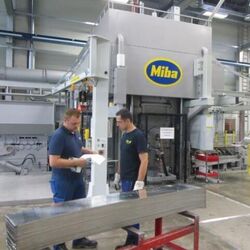
Miba Bearings Materials (MBM) specializes in roll bonding. This explicitly includes small quantities.
Many large manufacturers produce clad composite sheets in high-volume production runs. However, they often lack a point of contact for small quantities, special combinations or thick sheets up to 20 mm. MBM fills this gap.
Technical consulting begins with the material. Which material combination is suitable for the application? Which process makes technical and economic sense? These questions are clarified together with the customer.
For special requirements, MBM relies on belt casting technology. This process makes it possible to produce even small quantities of special aluminum alloys, which can then be applied to a substrate using roll bonding, among other methods.
Talk to our experts. Together, we’ll determine which process and material combination is right for your application.