Reducing wear with an intelligent pressure cccumulator
Hydrostatic bearings ensure low-wear operation and maximum smoothness, but come with high system costs.
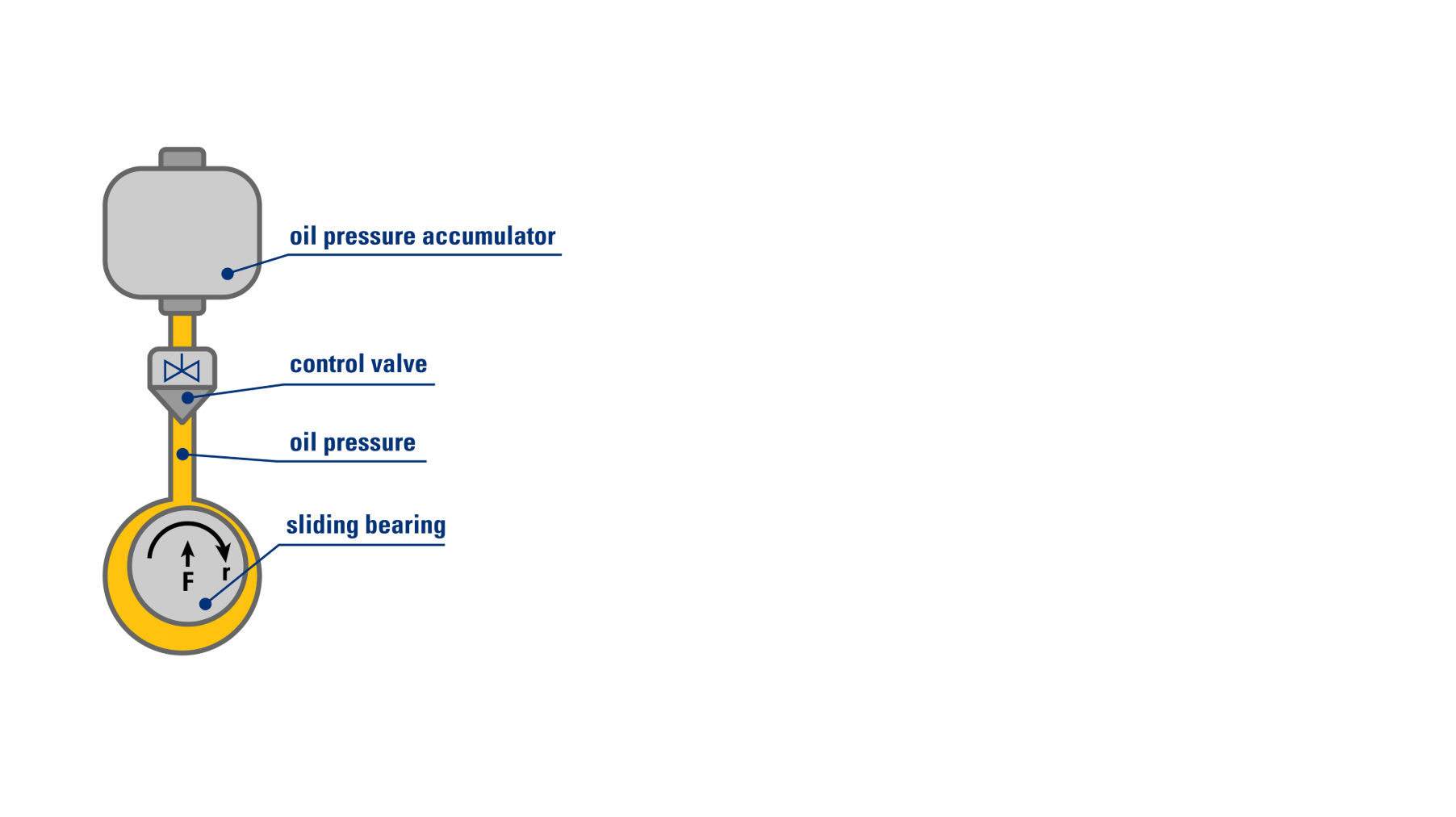
Through close collaboration between the customer and Miba, an alternative to conventional hydrostatic bearings can be implemented: The pressures generated in the lubrication gap during operation can be harnessed, stored, and specifically injected via a valve during periods of mixed friction. This makes it possible to lower the breakaway torque, reduce bearing wear, and improve start-stop performance. This can be achieved without additional pumps, without an external energy source, and using the existing oil. The result: a customizable, efficient alternative to hydrostatic bearings.
Hydrostatic bearings keep the shaft and bearing completely separated from one another by an externally supplied pressurized medium, usually oil. Even when the system is at a standstill, the lubricating film is actively formed, ensuring that the components remain separated and no mixed friction occurs.
In contrast, in hydrodynamic bearings, the load-bearing lubricating film is only formed by the rotational motion and the self-pumping effect of the shaft.
Hydrostatic bearings thus offer smoother operation and virtually wear-free service, but require a complex, energy-intensive pressure lubrication system with pumps, actively controlled components, and monitoring. They are primarily used in applications involving repeated start-stop cycles, load changes or low rotational speeds.
Even though hydrostatic bearings are nearly ideal for continuous operation, they introduce additional complexity. Pumps, lines, control systems, and a separate power supply increase both the space requirements and the system costs.
This is precisely where the solution comes in. Instead of implementing the full complexity of a conventional hydrostatic system, the oil pressures that naturally arise during operation in the lubrication gap are utilized, stored, and then precisely injected via a valve system.
This allows
This creates an alternative method that capitalizes on the advantages of hydrostatic bearings while requiring significantly less system complexity and offering higher efficiency.
During hydrodynamic operation, a load-bearing lubricating film forms in the lubrication gap. This pressure is not left unused but is specifically harnessed.
The oil is stored in a pressure vessel. A valve injects the stored oil into the lubrication gap precisely when the bearing enters the mixed-friction range. This typically occurs during start-up, shutdown, or at very low speeds.
This oil injection supports the lubricating film during the critical transition phase, thereby lowering the breakaway torque and reducing wear.
The result: significantly less wear and more stable performance during start-stop operation and at low speeds—without additional pumps, without an external power supply, and using the existing oil.

This alternative to hydrostatic bearings offers significant advantages for the system:
The system uses only the energy already available in the bearing. External pumps or additional drive systems are not required. The system operates using the existing lubricating oil supply.
No separate pressure medium is required. The existing lubricating oil performs all functions.
By specifically promoting the formation of a lubricating film, surface contact is minimized, which can lead to reduced wear and a longer bearing life.
A stable bearing installation in systems with repeated start-stop cycles, load changes, or low rotational speeds reduces the risk of damage that can lead to failures and costly repairs.
The solution can be customized to meet specific system requirements without having to completely redesign the entire bearing system.
This approach makes it possible to leverage the key advantages of hydrostatic bearing systems while significantly reducing investment costs and space requirements.
The result is an attractive alternative to traditional hydrostatic bearing systems, particularly for applications where the use of additional pump systems or large peripheral equipment needs to be avoided.
As a development partner for our customers, we combine an understanding of applications with bearing technology.
Our R&D teams combine in-depth expertise in bearings with hands-on experience from demanding start-stop applications.
This enables us not only to deliver a concept, but also to work with you to design the complete bearing system to meet your requirements.
From simulation and prototyping to series production, we guide you every step of the way—from the initial idea to a robust solution. For you, this means having a partner who doesn’t just develop components, but delivers viable bearing solutions.
Would you like to find out if this design approach is suitable for your application? Talk to our plain bearing experts about your bearing design, your operating conditions, and potential ways to reduce wear.
Contact us now!